Stop Asking People to Collaborate. Ask What They Need to Learn
September 14, 2026 · Adelee
Collaboration becomes powerful when leaders make learning—not meetings—the work
Written by: Adelee Penner

Abstract
Most leaders would say they want people to collaborate. We create teams, schedule meetings, establish communities of practice, provide shared planning time, and encourage people to work across roles and departments.
But collaboration itself is not necessarily evidence that people are learning together—or that their work is getting better.
Recent research on workplace and team learning suggests that leadership matters not simply because leaders organize opportunities for collaboration, but because they influence the conditions in which people question, reflect, share incomplete thinking, reconsider assumptions, learn from one another, and change what they do.
The more interesting leadership question may therefore be:
What do my clients, students, projects, and context need me to learn?
That question changes collaboration. It moves us from exchanging information to building understanding, from defending expertise to developing it, and from professional learning as something we attend to toward learning as something the work continually demands of us.
Collaboration has become one of those words that is difficult to argue against.
We want collaborative workplaces. Collaborative leadership. Collaborative teams. Collaborative professional learning.
We create committees, working groups, communities of practice, interdisciplinary teams, common planning time, retreats, networks, and shared digital spaces—all with the expectation that bringing people together will make the work better.
Sometimes it does.
Sometimes it simply produces more meetings.
That distinction matters.
I have worked with enough organizations to know that people can spend a great deal of time together without meaningfully changing what they understand or how they work.
A team can exchange information without examining it.
People can share practice without questioning it.
A meeting can reach a consensus without anyone learning very much.
A collaborative process can even reinforce what a group already believes.
So I have been wondering whether leaders sometimes ask the wrong question.
Instead of asking:
How do we get people to collaborate more?
I wonder what might happen if we asked:
What do my clients, students, projects, and context need me to learn?
For me, that is a much more demanding question.
And a much more interesting one.
Collaboration Is Not the Same as Learning
Recent research gives us good reason to make this distinction.
Hillberg Jarl's (2024) review of 40 studies examining leadership and workplace learning found that leaders influence individual and team learning through practices such as role modelling, relational support, and meaning negotiation.
That last idea interests me.
Negotiating meaning suggests something much richer than simply sharing information.
It means people are trying to make sense of something together. They are interpreting, questioning, connecting, revising, and perhaps even disagreeing as they develop a more useful understanding of the situation before them.
That does not happen simply because people have been placed around the same table.
Marlow and Lacerenza's (2025) meta-analysis of team learning further develops the argument. Their research synthesized 198 independent samples involving 15,536 teams. They found that team learning is associated with a range of motivational, affective, and cognitive factors—including team potency, psychological safety, and trust.
In other words, collaboration becomes meaningful not simply because people are present.
The conditions surrounding their interaction matter.
This changes the leadership challenge.
The question is no longer simply:
Have we given people opportunities to collaborate?
We also need to ask:
What becomes possible when they do?
RESEARCH DEEP DIVE
What 15,536 Teams Tell Us About Learning Together
One of the reasons I keep returning to Marlow and Lacerenza's (2025) research is its scale.
Across 198 independent samples representing 15,536 teams, the researchers examined what precedes team learning and what follows from it.
Their findings complicate a fairly common assumption: that if we put capable people together and give them a task, learning will naturally emerge.
It may not.
The meta-analysis points toward something more relational and contextual.
Team learning was associated with motivational conditions, such as whether people believed the team could succeed; affective conditions, including psychological safety; and cognitive conditions, including trust.
That is important for leaders.
Because these are not meeting-management issues.
They are conditions-of-work issues.
If people do not trust one another, collaboration is constrained.
If questioning a decision carries a social cost, collaboration is constrained.
If people believe that uncertainty signals incompetence, collaboration is constrained.
If expertise is concentrated in a few voices while others learn that their perspectives carry less weight, collaboration is constrained.
If the team never stops long enough to examine what it is learning, collaboration is constrained.
The research does not provide a five-step recipe for forming collaborative teams.
I am glad it doesn't.
Instead, it invites leaders to pay much closer attention to the environment in which people are being asked to learn together.
That may be the deeper leadership work.
What Is the Work Asking Us to Learn?
This is the part of the argument I want to stay with.
Professional learning often begins with someone identifying what other people need to know.
A leader sees a gap.
An organization establishes a priority.
A new initiative arrives.
A professional development session is organized.
An expert is invited.
Information is delivered.
There is absolutely a place for that kind of learning.
Sometimes we need to acquire knowledge, develop technical expertise, or understand evidence.
But it cannot be the whole architecture for professional learning.
Because in complex work, the learning needs are often not fully visible in advance.
It emerges through the work.
A teacher notices that an approach that worked beautifully with one group of students is producing very different results with another.
A leadership team discovers that a seemingly straightforward policy change is creating unintended consequences.
A consultant realizes that a client's presenting problem may not actually be the problem that needs solving.
A project team finds that an implementation plan developed six months earlier no longer fits the conditions they face.
A superintendent hears a question from a student, teacher, trustee, or parent that unsettles the system's existing explanation.
A team receives evidence that does not fit comfortably with the story it has been telling itself.
Those moments are not interruptions to the work.
They are the work.
And each of them carries a learning demand:
What does this situation require me to understand that I do not understand yet?
That question is profoundly different from asking:
What training should I take?
It positions learning as responsive rather than merely prescribed.
It also requires a different understanding of expertise.
Expertise Cannot Mean Having Finished Learning
One of the quiet difficulties of leadership is that expertise can become something we feel obligated to perform.
Leaders are expected to know.
People bring us problems because they assume we can help resolve them. We are asked for direction, interpretation, judgment, and decisions.
Over time, it can become surprisingly easy to equate credibility with certainty.
But uncertainty is not always a deficit in leadership.
Sometimes it is information.
A problem we cannot immediately solve may be telling us that our existing knowledge is insufficient for the conditions we are encountering.
That is where research on leader humility becomes particularly interesting.
Rigolizzo, Zhu, and Harvey (2022) studied 518 employees working with 66 managers and found that leader humility was positively associated with employees' informal workplace learning.
Son and Yang (2023), examining 311 employees in 59 teams, similarly found a positive relationship between leader humility and team reflexivity, with shared leadership and trust playing important roles.
Humility in this sense is not self-deprecation.
Nor does it mean that leaders pretend not to know things they actually know.
It means holding expertise alongside openness.
A leader can know a great deal and still say:
I had not considered that.
What are you seeing that I may be missing?
Why do we think this is happening?
What evidence would cause us to reconsider our assumption?
What do we need to understand before we decide?
And perhaps most importantly:
What is this situation asking us to learn?
Those are not weak leadership questions.
They are questions that make room for intelligence beyond the leader.
Collaboration Should Help Us Notice What We Could Not See Alone
This may be one of the most valuable purposes of collaboration.
Not efficiency.
Not agreement.
Not even idea sharing.
Seeing more.
Every person enters a problem with a partial view.
Our professional preparation shapes what we notice. So do our roles, experiences, responsibilities, disciplinary knowledge, relationships, histories, and assumptions.
That partiality is not a flaw.
It is simply one of the realities of complex organizations.
The problem arises when we mistake our partial view for a complete one.
Good collaboration interrupts that.
Someone else notices an effect we did not see.
Someone asks a question we had stopped asking.
Someone closest to implementation explains how a decision actually plays out in practice.
Someone with a different expertise recognizes a pattern.
Someone new to the organization asks the seemingly naïve question that exposes an assumption everyone else had normalized.
Someone we serve—our student, client, family member, community member, or partner—tells us that the experience we designed is not the one they are having.
Collaboration becomes powerful when those differences are not simply represented around the table but are actually allowed to influence the thinking of the group.
That requires more than invitations.
It requires conditions.
Psychological Safety Is Part of the Learning Infrastructure
People cannot contribute what they know—or question what the group thinks it knows—if the interpersonal cost is too high.
That is where psychological safety enters the collaboration conversation.
Leblanc, Harvey, and Rousseau's (2024) meta-analysis of team reflexivity found relationships among participation-supportive leadership, psychological safety, team reflexivity, and performance. Their findings help demonstrate why leadership practices that support genuine participation matter for teams attempting to examine and adjust their work.
Sometimes we describe psychological safety as though it means making people comfortable.
I see it differently.
Psychological safety matters because learning requires interpersonal risk.
To learn together, somebody eventually has to be willing to say:
I don't understand.
I disagree.
I think our original assumption may be wrong.
The plan is not working the way we expected.
I made a mistake.
I need help.
I see something differently.
Could we reconsider this?
None of those statements is necessarily comfortable.
But each one can be extraordinarily productive.
The leader's job is not to remove every tension from collaborative work.
It is to help create conditions in which tension, difference, uncertainty, and incomplete thinking can be used for learning rather than interpreted immediately as incompetence, obstruction, or disloyalty.
Reflexivity: The Part of Collaboration We Often Skip
Another important idea running through this research is team reflexivity.
Reflexivity occurs when a team examines its goals, strategies, processes, assumptions, or results and adapts its approach accordingly.
I think of it as the difference between simply having an experience together and actually learning from it.
Organizations are often very good at activity.
We launch.
Implement.
Meet.
Present.
Consult.
Deliver.
Measure.
Report.
Then we move quickly to the next thing.
Reflexivity interrupts that movement just long enough to ask:
What happened?
What are we noticing?
What surprised us?
Whose experience are we not yet understanding?
Where were our assumptions correct?
Where did reality behave differently than we expected?
What have we learned that should change what we do next?
The 2024 meta-analysis by Leblanc and colleagues is useful here because it suggests that reflexivity is not simply a characteristic of unusually thoughtful teams.
The conditions surrounding the team—including leadership that encourages meaningful participation and psychological safety—matter.
This moves reflection out of the realm of the nice closing activity at the end of the meeting.
It becomes part of organizational intelligence.
TRY THIS IN PRACTICE
Change One Question on the Agenda
You do not need to redesign your entire organizational learning strategy to begin.
Try changing one question in one meeting.
Choose an existing team conversation—a project meeting, professional learning community, leadership meeting, implementation check-in, staff meeting, client debrief, or planning session.
At the top of the agenda, add:
What does this situation need us to learn?
Then resist the temptation to answer it too quickly.
You might follow it with:
-
What are we noticing?
-
What do we not understand yet?
-
Whose perspective would help us understand this differently?
-
What evidence are we using?
-
What assumption might we need to test?
-
What would we do differently if what we are learning is true?
Then return to the question at the next meeting.
What have we learned since we last talked?
The power is not in adding another reflection activity.
The power is in making learning consequential.
If the team learns something important, let it change something:
a decision,
a process,
a resource,
a timeline,
a strategy,
a conversation,
or a practice.
Otherwise, people quickly learn that reflection is performative.
Leaders Do Not Need to Own Everyone's Learning
There is something liberating in all of this for leaders.
You do not have to determine every learning need for every person.
In fact, trying to do so may inadvertently create dependency.
What leaders can do is build an environment in which people become increasingly capable of recognizing the learning demands embedded in their own work.
Imagine staff entering a planning conversation asking:
What do my students need me to learn?
Imagine a project team asking:
What is this implementation teaching us that the original plan could not have predicted?
Imagine consultants asking:
What do we need to learn from this client before deciding what support would actually be useful?
Imagine organizational leaders asking:
What is changing in our context that requires us to reconsider what we think we know?
Imagine a team encountering disappointing results and asking:
What might this evidence be trying to teach us?
Now, professional learning is no longer separated neatly from professional practice.
The workplace is one of the places where learning happens because people deliberately pay attention to the questions their work raises.
That is a very different learning culture.
So What Does a Leader Actually Do?
Perhaps the first move is surprisingly simple.
Before organizing another collaborative structure, clarify its learning purpose.
Instead of:
Let's get everyone together to share best practices.
Try:
What are we seeing in our work that our current practice does not adequately explain?
Instead of:
We need greater collaboration across departments.
Try:
What does each group know that the others need in order to understand this problem more fully?
Instead of:
We need professional development on this issue.
Try:
What do we need to know, and what evidence tells us that this is the learning need?
Instead of:
Who has the answer?
Try:
What do we need to understand before choosing an answer?
Then, leaders need to protect the conditions around those questions.
Make room for different perspectives.
Allow people to bring evidence that complicates the preferred story.
Model changing your own mind.
Treat questions as contributions rather than delays.
Give people enough time to think together rather than filling every collaborative space with agenda items.
Return to decisions after implementation and ask what has been learned.
Notice whose knowledge is routinely sought and whose is routinely overlooked.
And make learning consequential.
If a team discovers something important, let that discovery change the work.
Collaboration Should Leave Something Different Behind
Perhaps this is the test I will be carrying into my own work.
After people collaborate, what is different?
Not just:
Did everyone participate?
Did we finish the agenda?
Did people enjoy the meeting?
Did we produce a document?
Did everyone have an opportunity to speak?
But:
What do we understand now that we did not understand before?
What assumption changed?
What new question emerged?
Whose perspective changed our thinking?
What will we do differently because we learned something together?
Those questions set a much higher bar for collaboration.
But they also make collaboration worth the time it requires.
In increasingly complex organizations, we cannot expect leaders—or anyone else—to possess all of the knowledge required before the work begins.
Conditions change.
People respond differently than anticipated.
New technologies emerge.
Communities shift.
Evidence accumulates.
Our clients and students tell us things we did not know to ask.
Plans meet realities they could not fully predict.
The organizations most capable of responding may not be the ones with leaders who know the most.
They may be the ones where people have learned how to keep learning—from the work, from one another, and from the people they serve.
So perhaps the next time we find ourselves asking people to collaborate, there is another question worth putting on the table first:
What do my clients, students, projects, and context need me to learn?
And then, as leaders, we need to make it possible to find out.
Leadership Through Collaboration
Collaboration is not the goal. Better understanding, better decisions, and better practice are.
What do my clients, students, projects, and context need me to learn?
A learning culture is not built only by leaders who know. It is also built by leaders who make it safe and worthwhile not to know yet.
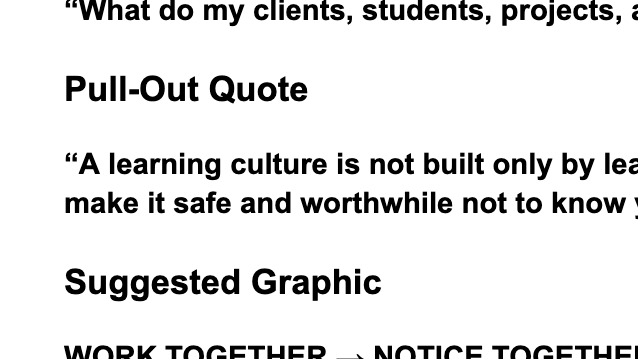
WORK TOGETHER → NOTICE TOGETHER → LEARN TOGETHER → ACT DIFFERENTLY
Collaboration has value when it changes what we understand and what we do.
A Final Provocation
What if the quality of collaboration in an organization were measured not by how often people worked together, but by how often working together changed what they understood and what they did?
That might give us a very different picture of a collaborative workplace.
Reflective Questions
Where in your organization has collaboration become an activity rather than a learning process?
What are your clients, students, communities, projects, or current conditions telling you that you may still need to learn?
When someone on your team says, “I don't know,” what happens next?
Whose knowledge is most likely to shape collaborative conversations in your organization? Whose knowledge may be present but underused?
When evidence challenges an existing assumption, does your organization become curious—or defensive?
How often does reflection actually change a decision, process, strategy, or practice?
And perhaps the question to carry into your next collaborative conversation:
What does this situation need us to learn?
Let's talk again soon. Take good care of yourself.
Adelee
References
Hillberg Jarl, F. (2024). The impact of leadership on the workplace learning of individuals and teams: A literature review and synthesis. The Learning Organization, 31(3), 411–439. https://doi.org/10.1108/TLO-11-2022-0144
Leblanc, P.-M., Harvey, J.-F., & Rousseau, V. (2024). A meta-analysis of team reflexivity: Antecedents, outcomes, and boundary conditions. Human Resource Management Review, 34(4), 101042. https://doi.org/10.1016/j.hrmr.2024.101042
Marlow, S. L., & Lacerenza, C. N. (2025). There is no end to learning, but how does it begin? A meta-analysis of the team learning pathway. Journal of Management Studies, 62(2), 597–631. https://doi.org/10.1111/joms.13064
Rigolizzo, M., Zhu, Z., & Harvey, J.-F. (2022). Leader humility, leader authenticity and informal learning: How humble team leaders model everyday workplace learning. Journal of Workplace Learning, 34(8), 691–706. https://doi.org/10.1108/JWL-01-2022-0010
Son, S., & Yang, T. S. (2023). How leader humility influences team reflexivity: A team level analysis. Team Performance Management: An International Journal, 29(5/6), 225–241. https://doi.org/10.1108/TPM-02-2023-0013
About Adelee Penner and Elk Willow Consulting
Adelee Penner is an educational leader, researcher, consultant, and CEO of Elk Willow Consulting. Her work is grounded in a belief that meaningful change is built with people rather than imposed upon them. She works alongside leaders, teams, and organizations to examine complex problems, strengthen organizational learning, create shared language, and translate ambitious ideas into thoughtful action.
Elk Willow Consulting partners with educational and organizational leaders through consulting, professional learning, coaching, engagement, system analysis, and implementation support. Rather than arriving with predetermined answers, Elk Willow's approach emphasizes listening, curiosity, evidence, systems thinking, and practical implementation. The goal is not simply to solve today's problem, but to strengthen the capacity of people and organizations to learn, adapt, and move forward thoughtfully when the next challenge emerges.
At the centre of the work is a commitment to creating the conditions in which people can think deeply together, see new possibilities, and turn learning into meaningful improvement.